Read a few pages. - Enjoy!
A Miracle at Attu: The Rescue of CG-1600 - SAMPLE
PREFACE
U. S. Coast Guard personnel have gone into harm’s way to rescue and assist others for 226 years (1790-2016). In 1982 the U. S. Coast Guard responded to 68,552 search and rescue cases saving 5,675 lives. This book is an historic nonfiction account documenting one of those rescues. This was a unique rescue as it involved a U. S. Coast Guard HC-130H that crashed on a logistics mission to the remote Coast Guard Long Range Navigation Station on Attu Island Alaska. The names and events described in this book were derived directly from first-hand accounts provided by Coast Guard logs, records, news releases, and interviews obtained through Freedom of Information Act requests. I used my own notes and knowledge as the rescue pilot, as well as my co-pilot’s, to describe the rescue as it unfolded. I supplemented the official documents with additional survivor and rescuer interviews conducted over 30 years after the mishap. Several hundred hours of hours of research was completed to corroborate the facts presented in the book. No characters were added, no names changed, and no events fabricated.
The Coast Guard was more than a job for me, it was a “calling” and I would say for most that made it a career. It takes a special person to go into harm’s way and fly into the storm so others may live. I was both honored and blessed to have served with the most dedicated and professional men and women for over 30 years (1972-2005) in the Coast Guard.
It is my hope this book serves three purposes: to describe the selfless actions of the men and women of the U. S. Coast Guard who conducted the rescue; to raise awareness of the work the Coast Guard accomplishes in service of our nation; and to help raise awareness of Coast Guard Aviation “flying into the storm” during our 100th anniversary celebration (1916-2016)
Chapter One - Answering the Call
“Bill, we have a possible downed aircraft.”
Lieutenant (LT/03) Jim Sabo, Operations Officer on Coast Guard High Endurance Cutter Mellon (WHEC 717), looked at us anxiously as LT Mike (Wally) Wallace, my copilot, and I reached the bridge of Mellon, responding to his urgent request. Wally and I had had just returned from a morning law enforcement flight, landing our HH-52 helicopter aboard the cutter’s diminutive flight deck, near Buldir Island at the western end of the Alaskan Aleutian chain.
0940 local Friday 30 July 1982
Standing beside Sabo on the bridge by the navigational chart on the Quartermaster’s table, we heard an auto alarm on the high-frequency radio emergency channel, 2182 kHz, followed by an urgent safety broadcast from Coast Guard Communications Station (COMSTA) Kodiak: “PAN PAN (pause) PAN PAN (pause) PAN PAN (pause) This is Communications Station Kodiak, Communications Station Kodiak, A US Coast Guard HC-one thirty, Coast Guard number one-six-zero-zero, is missing on a flight from Shemya Air Force Base (AFB) to Attu Alaska; any mariner in contact with or having information on Coast Guard number one-six-zero-zero contact ‘COMSTA’ Kodiak immediately.”
The message was repeated; no one was listening. Our minds had instantly raced to the possibility of a downed Coast Guard (CG) HC-130H and thoughts of the aircrew and shipmates that may be in danger.
I immediately told Sabo I had heard a radio transmission, from CG-1600 around 0825, stating, “Landing in ten” when we were flying our fisheries patrol. This new information was immediately relayed back to COMSTA Kodiak by Mellon.
0942
Coast Guard North Pacific Search and Rescue Coordinator (NORPACSARCOORD) in Juneau, Alaska, ordered Mellon to “proceed at best possible speed to the last known position of Coast Guard sixteen hundred”.
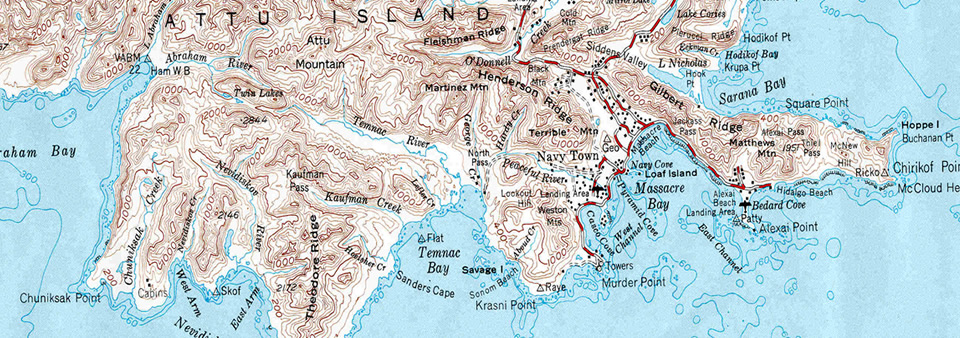
The HC-130’s last suspected position was on final approach for a landing at Casco Cove, Attu Island, Alaska. Mellon, with a deployed helicopter aboard, immediately diverted from its assigned Alaskan Fisheries Patrol (ALPAT) to begin the Search and Rescue (SAR) mission. The cutter’s Commanding Officer (CO), Captain (CAPT/06) Martin Daniell, ordered the helmsman to come about to a westerly heading of 290 degrees and then notified the ship’s crew of the situation via the shipboard public addresses system.
“Mellon is proceeding at best speed back to Attu; Juneau has designated Mellon the On-Scene Coordinator for a possible downed Coast Guard HC one thirty on its logistics flight from Shemya AFB to Attu.”
Everyone on Mellon was on an adrenalin rush. This was “one of our own”; a Coast Guard aircraft and aircrew that were missing. For our-six man helicopter crew deployed aboard Mellon from Coast Guard Air Station (CGAS) Kodiak, AK,the news was even more shocking because personal friends and workmates were onboard the missing aircraft. We had just rendezvoused with the CGAS Kodiak HC-130H, CG-1600, a few days before at Attu Island to receive a new helicopter battery during the first of their many logistics sorties to resupply Coast Guard Long Range Navigation (LORAN) Station Attu.
On Wednesday 28 July at 1730 local, CG-1600 had been parked on the tarmac at the Casco Cove runway next to our HH-52A, CG-1425. CG-1600 was on a routine scheduled logistics mission to keep the remote LORAN Station running. HC-130s from Kodiak were the life line for the isolated Alaskan LORAN Stations of Attu, Port Clarence, and St. Paul. The arrival of the logistics flights was always uplifting for the station crew. The crew of CG-1600 had just flown from Kodiak to Attu with a brief stop in Adak, a distance of 1,195 nautical miles (nm) or the approximate distance from Miami, FL, to Boston, MA.
This would be one of many sorties planned for CG-1600 into Attu. CG-1600 would also fly some short fisheries enforcement flights in support of Mellon, depending on weather, as a bonus since they were deployed to this area. It was standard for all Coast Guard logistics flights to conduct multi-missions when operating from remote locations when possible.
I had contacted CGAS Kodiak via high-frequency radio (HF) phone patch to coordinate a new battery for us because the current helicopter battery was not maintaining its charge. My crew had already changed out batteries once, with a spare carried in the helicopter support kit (HSK); this would mean we would have a fresh spare. CG-1600 would stage from Shemya AFB with its 10,000-foot runway and facilities, only 35 nm east of Attu, on its 3-day supply and fisheries enforcement missions. It was very rare that two CGAS Kodiak-based aircraft were at Attu simultaneously. It was also very rare that the Aircraft Commander’s (AC) for the HC-130 and the HH-52, LT Mark Whyte and me, were next-door neighbors at base housing in Kodiak.
On my way to the helo from the LORAN Station, I saw Mark and said hello; thanked him for bringing out the battery; and asked him to pass a message to my wife, Tina, that “All was well. We’re all doing fine on the ALPAT.” Mark was scheduled to get back to Kodiak on Friday 30 July, and I would be deployed another month on Mellon in the Bering Sea. In 1982 ALPAT AVDET deployments were for approximately 60 days and we had limited to no communication capability (e.g., no email or text messaging) while deployed to talk with our loved ones.
Mark said no problem; he’d pass the message on and for us to be safe as I climbed into CG-1425 to fly back to Mellon. Wally opened his cockpit window and handed Mark a letter to his wife Sharon and asked if he would deliver it. Mark replied, “I will.” Neither of us knew the message and the letter would not be passed as requested…
Mellon was now heading toward the western flanks of Attu Island in Alaska’s Aleutian chain. Daniell ordered all ahead full. The cutter’s two Fairbanks-Morse diesel engines accelerated and delivered all of their 7,000 horsepower. The engines, which are a larger version of a 1968 diesel locomotive design, now propelled the 2,478-ton High-Endurance Cutter through the seas at 17 knots, but more speed was necessary.
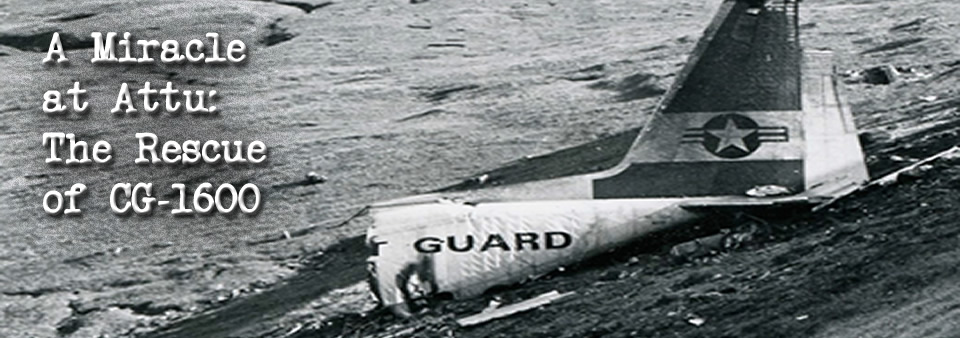
Close up of tail section facing 180 degrees from impact direction. USCG photo.
Above crash site lower debris field looking down slope toward Krasni Point. USCG photo.
Crash site photo taken from eastern vantage point near Murder Point facing west.
Note deep ravine and telephone poles near Rescue-1425 transit path. USCG photo.